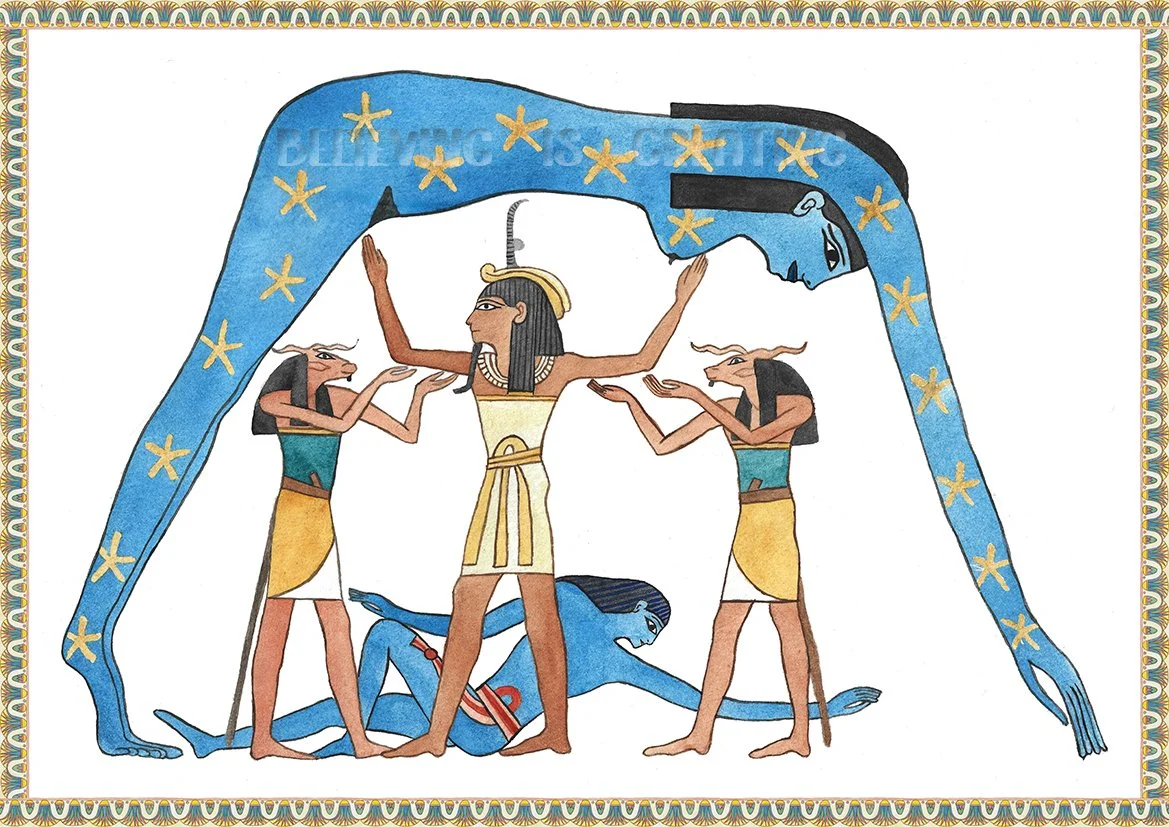
In Egyptian myths we find this same story of creation through the word on several occasions. According to one Egyptian myth, at the beginning there was no light. There was only darkness and a vast expanse of water called Nun. The power of this aquatic divinity was so great that, from within the penumbra, it brought forth a great and radiant egg. And from within that egg emerged Ra, the invisible Creator. Ra had the ability to do whatever he wished, even to change form; the form he most often adopted was that of a bird. Another of his abilities was that whatever he named would take form and become real. So important was the power of the Name that he carefully guarded the secret of his own name, so that no one could use it. In this way, he set out to create the Sun, saying: “At dawn I am called Khepri, at midday Ra and at dusk Atum.” Then the Sun appeared for the first time, illuminating the darkness; it rose above the horizon and, at dusk, descended to hide. He then named Shu, and the winds gathered for the first time, beginning to blow. When Ra named Tefnut, the rain made its presence known with its drops. Later he named Geb and, as his name was pronounced, the firm earth was formed. To give him company, he named the goddess Nut, and the firmament -the celestial vault- arched over the plane of the earth. Thereafter, Atum, in a display of his power, created a surface upon the depths and, within it, a mound of earth -a mountain-. The centre of that mound was Egypt, and the Nile flowed directly from the primordial waters. Then he named Hapi, and the river began to flow through Egypt, fertilising its wide valley. Ra began to name, one by one, all the things that exist upon the earth, and they became visible and grew. Finally, he gave a name to men and women, and from that moment humanity populated the earth.