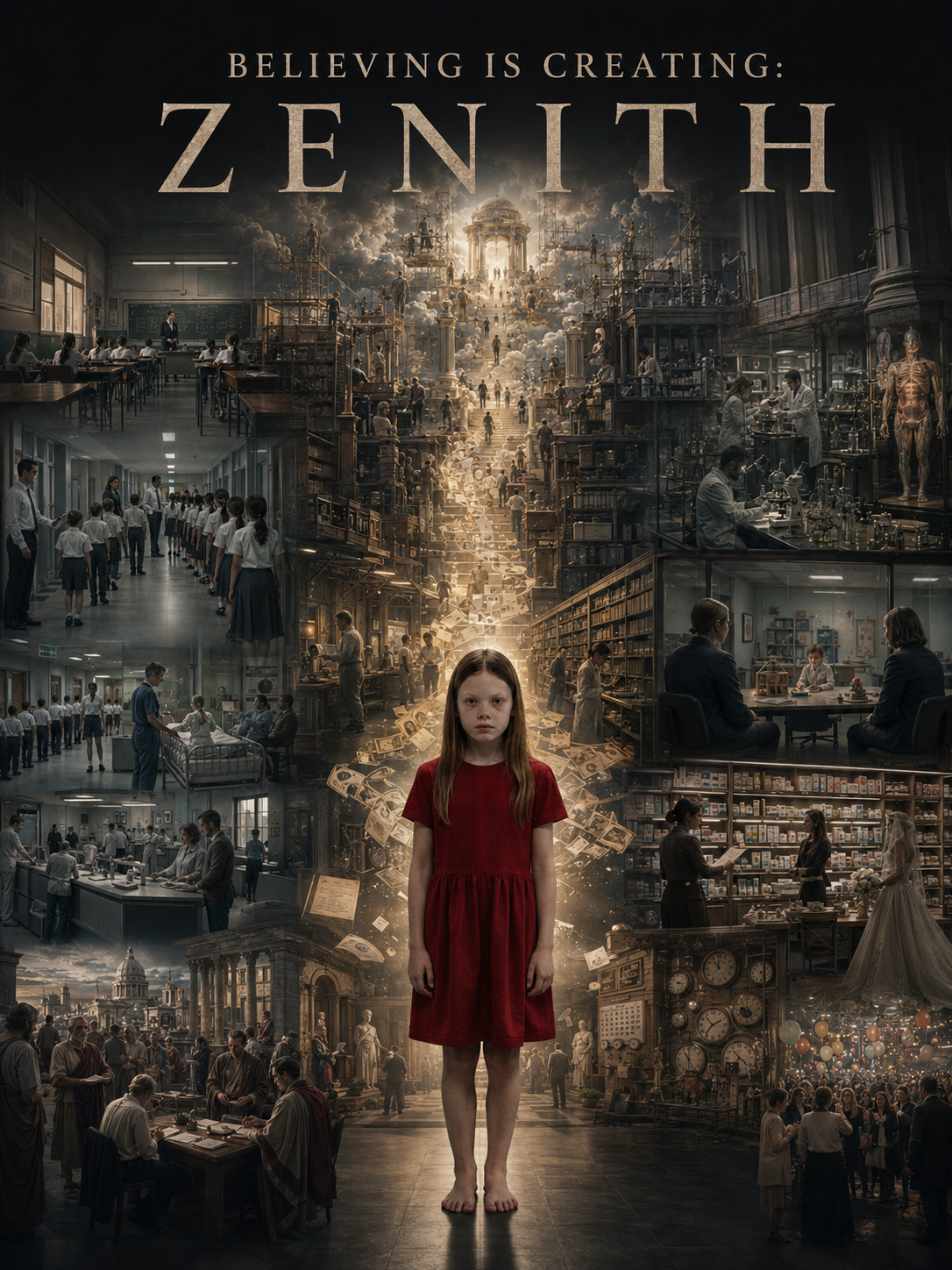
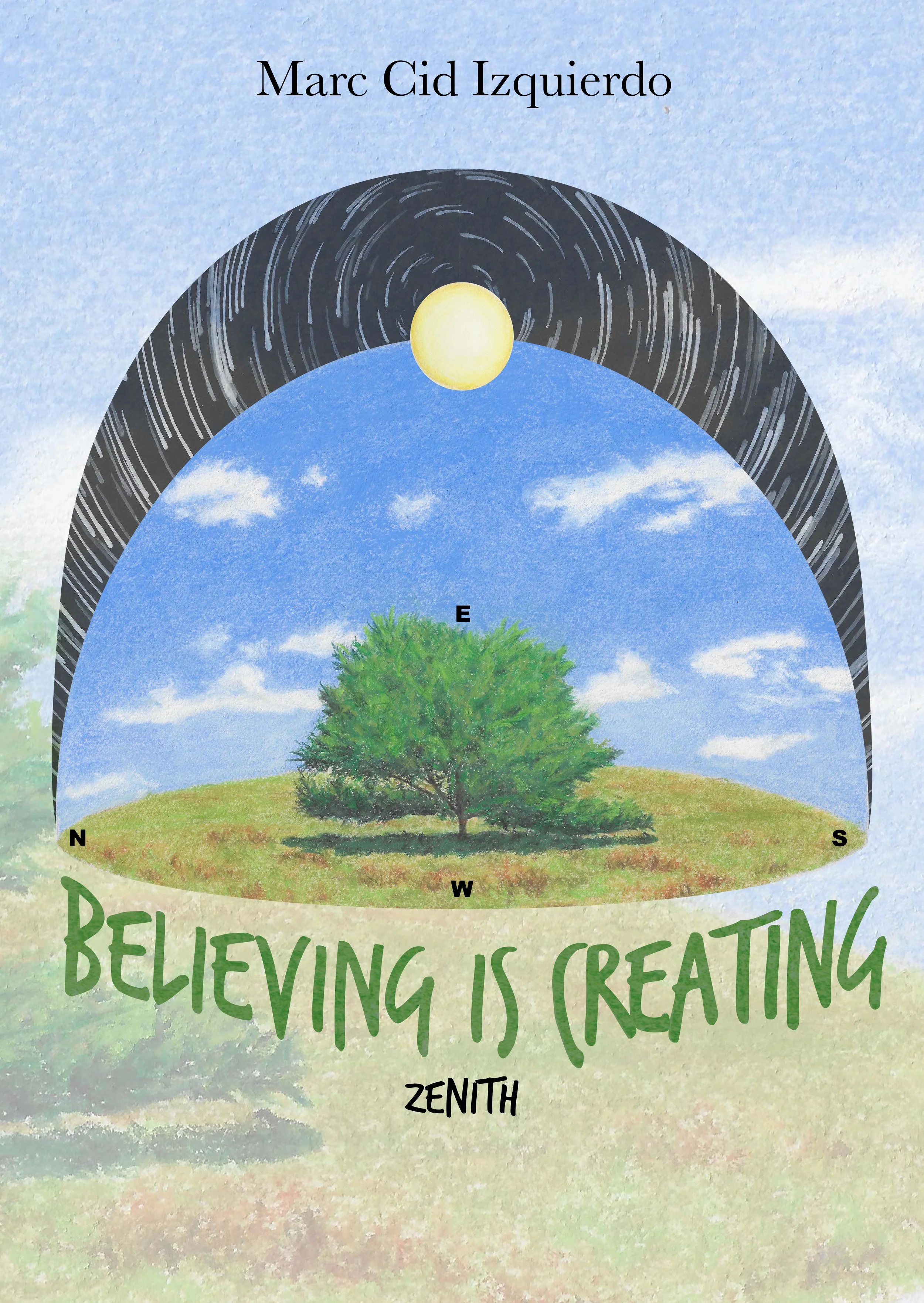
Believing is Creating - Zenith

Sometimes it is not the truth that is lacking, but the capacity to sustain it without distorting it.
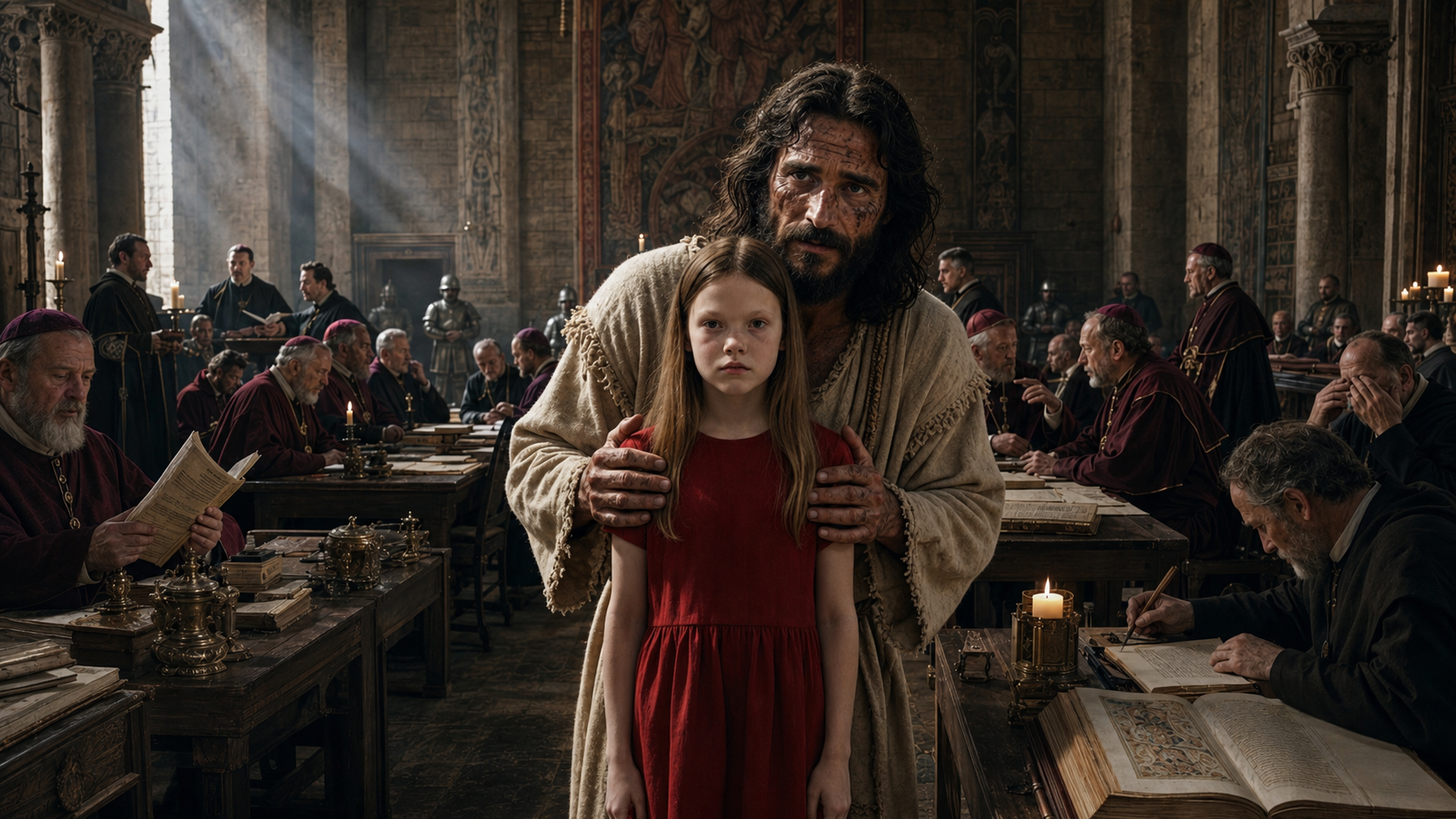
The Assembly

Believing is Creating: Zenith - Season One

“Do you still think you have lived, and you are living, the life you truly want to live?” The Doctor

Would you rather enter through film?

The Assembly - Believing is Creating: Zenith transforms the documentary and philosophical work behind the book into an extended cinematic experience.

The complete first season brings together more than 100 chapters, original extracts from the book and a new narrative arc that continues beyond its pages.

The Assembly - The extended series of Zenith

“You were given a programmed life, filled with beliefs of questionable origin and ideologies warning of a dramatic ending.” The Doctor

THE SCIENCE OF EXCLUSION AND CONJECTURE: Who Decides What Is Real? / 9 EPISODES

Every age constructs a version of reality and inevitably mistakes it for reality itself.

This series explores the mechanisms through which a society decides what may be considered true, what deserves to be investigated and what must remain beyond the boundaries of accepted knowledge. Beginning with the work of Charles Fort and his celebrated The Book of the Damned, it enters the history of the facts, phenomena, questions and possibilities that were excluded not necessarily because they had been disproved, but because they could find no place within the system attempting to understand them.

But this is neither a defence of the extraordinary against science nor an invitation to replace one dogma with another. It is an investigation into the boundary that separates them.

Through The Damned, The Science of Exclusion, Scientific Dogma, What Does It Mean to Know?, The Illusion of Knowledge, The Prison of Categories, The Impossible Truth, The World You Cannot See and The Error of Objectivity, the series examines how classifications organise our perception, how methods determine what they are capable of finding and how every certainty must exclude certain possibilities in order to preserve its coherence.

Science appears here not as an enemy, but as one of the greatest achievements of human thought: a method capable of correcting itself, questioning itself and transforming its own conclusions. Yet when its provisional limits are mistaken for the definitive limits of reality, method can become authority, doubt can become heresy and the absence of an accepted explanation can be mistaken for proof that whatever remains unexplained does not exist.

The investigation eventually moves away from institutions and towards the individual.

Because knowing does not consist merely of accumulating information. We may know someone’s name, history, decisions, habits and diagnoses and still have no knowledge of who they are. We may measure an experience without ever understanding it. We may describe the world with extraordinary precision while continuing to see only what our instruments, categories and beliefs allow us to recognise.

The series does not attempt to prove that everything excluded is true. It asks a more uncomfortable question: how many things were declared impossible before they were ever truly observed?

It offers no new official version of reality. It exposes the process through which official versions come into existence.

Because what a civilisation calls knowledge does not merely reveal what it has succeeded in understanding. It also preserves the trace of everything it had to condemn before it could call that knowledge truth.

Every truth begins as something condemned.
And the moment something becomes true, something else takes its place outside it.
That is how every world is built.

The Science of Exclusion and Conjecture | Chapter 1 of 9. Before an idea is accepted, it is usually condemned. The Damned is the first chapter of The Science of Exclusion and Conjecture, a nine-part cinematic series exploring how societies decide what may be considered true, what deserves to be investigated and what must remain outside accepted knowledge.

The Science of Exclusion and Conjecture | Chapter 9 of 9. Who taught you who deserves to be wrong? The Error of Objectivity is the ninth and final chapter of The Science of Exclusion and Conjecture, a cinematic series exploring how knowledge, authority and belief construct the boundaries of accepted reality.

VICTIMS AND EXECUTIONERS / 9 EPISODES

What is a victim?

Long before it came to describe someone who had suffered harm, victima named the living being destined or offered for sacrifice. To sacrifice came from sacrum facere: to make something sacred. The victim gave something of itself to establish contact between giver and receiver, between the human being and whatever was considered greater than the self. But words change their meaning, and with them changes the reality we are capable of living.

The victim ceased to be the one who offered themselves for sacrifice and became the one who had been sacrificed. Choice disappeared from the word. Then responsibility disappeared. Only the harm remained, together with the need to find someone who had caused it. And so the executioner was also born..

Victims and Executioners is a nine-part cinematic series about the transformation of sacrifice, the construction of innocence and the way suffering can become an identity. It does not investigate whether harm exists. Harm exists. It investigates what happens afterwards. What happens when we stop saying, “Something happened to me,” and begin saying, “This is what I am”? When does a wound cease to describe an experience and begin deciding who deserves to be heard, who must be protected and who must carry all the blame?

Because every victim needs a cause. Every cause eventually acquires a face. And when innocence is concentrated entirely on one side, the other ceases to be a person and becomes the executioner. Then we no longer need to understand them. We need only condemn them.

Through language, sacrifice, guilt, responsibility, relationships, institutions, wars and collective identities, the series examines how we learnt to contemplate reality from two apparently irreconcilable positions: the one who suffers the harm and the one who causes it. Yet no life remains forever on only one side.

We can be victims of a structure while helping to preserve it. We can suffer one form of violence and reproduce it upon others. We can use what was done to us to justify what we later begin to do. We can point towards the executioner without noticing the moment when our need to punish them turns us into what we believed we were fighting.

The victim and the executioner are not equivalent. Nor are they completely separate. The victim may have suffered without choosing the wound. But what they do from within it will also have consequences. The executioner must answer for the harm they caused. But turning them into the absolute embodiment of evil does not repair the victim. It merely allows the same mechanism to continue changing bodies.

This series does not attempt to remove responsibility from those who cause suffering. It attempts to return responsibility to everyone. Because responsibility does not mean culpability. It means recognising that we also participate in the reality our words, decisions, silences and beliefs help to sustain. Across nine episodes, Victims and Executioners dismantles the most comfortable position from which we have learnt to contemplate harm: the one in which we are always the consequence and others are always the cause.

We remember precisely what was done to us. We explain in detail why it hurt us. We name those responsible. But we rarely follow the wound far enough to discover what it began to make of us. The final question is not whether you were ever a victim. You probably were. The question is how many people then had to become your executioners so that you would never have to stop being one.

We are victims and we are executioners.

And perhaps both roles continue to exist because each needs to believe it has only ever been one.

Victims and Executioners | Chapter 1 of 9. What if suffering was never the original meaning? The Original Victim is the first chapter of Victims and Executioners, a nine-part cinematic series exploring how sacrifice, suffering, innocence and responsibility became identities through which we understand ourselves and others. Before the word victim came to describe someone harmed by another person or event, the Latin victima referred to a living being destined or offered for sacrifice. Sacrifice, from sacrum facere, carried the meaning of making something sacred.

Victims and Executioners | Chapter 9 of 9. What if the person you fear most is only you under different circumstances? Under Different Circumstances is the ninth and final chapter of Victims and Executioners, a cinematic series exploring suffering, guilt, moral identity and the unstable boundary between those who are harmed and those who cause harm. We protect our sense of innocence by imagining that an executioner belongs to a different kind of humanity.

THE GAMES OF THE GODS / 7 EPISODES

What do we win when our team wins?

We say that we have won. We celebrate, sing, raise our arms and defend the colours carried by someone in our name. If they lose, we lose as well. We become angry, search for someone to blame and await the next opportunity to repair a defeat in which none of us actually participated. But what have we won? A match. A race. A fight. The demonstration that our representative ran faster, struck with greater precision or managed to move a ball to the agreed place before the representative of others.

The Games of the Gods is a seven-part cinematic series about the transformation of sport from ancient ritual into the contemporary entertainment industry. It does not investigate physical activity as a form of health, bodily development or human expression. It investigates the moment movement was organised, regulated and transformed into a competition capable of representing religious, political and economic conflicts. Because sport did not begin solely as entertainment. Before the stadium, there was the ceremonial ground Before the professional athlete, there was the body offered to the ritual. Before the national team, there were cities sending their representatives. Before the medal, there were the crown, glory and the favour of the gods.

The earliest physical activities accompanied hunting, survival, dance and ceremony. Over time, societies transformed movement into trial, trial into competition and competition into a representation of collective order. It was no longer only the player who participated. Their people participated as well. The athlete began to compete for those who remained watching. Their body ceased to belong entirely to them and became the allegory of a community: the chosen one who endures discipline, pain, exposure and the possibility of defeat in the name of everyone. This is how the sporting hero was born. If they win, we win. If they lose, we lose. And while we mistake their result for our own, the competition succeeds in producing an experience of belonging among millions of strangers.

The series moves through the Mesoamerican ritual ball game, the Greek agones, the Olympic truce, the city-states, ceremonies, oaths and bodies trained to represent something greater than themselves. Not to claim that every form of sport had a single origin, but to reveal a structure that has survived its gods. The altar became the podium. The offering became the athlete. The city-state became the nation. The emblem became the shirt. The congregation became the supporters. And the ancient battle returned each week under rules that allowed us to call it a game.

Modernity did not separate sport from politics. It placed politics inside the athlete’s body. A flag can run, jump, fight and score. A nation can symbolically demonstrate its strength without declaring war. A conflict between communities can be compressed into a result and resolved, for a few hours, upon a scoreboard. But the game did not remain exclusively within the nation. It migrated towards the corporation. Clubs organised belonging. Brands dressed the heroes. The media multiplied their image. Betting transformed uncertainty into a product. Sponsors purchased part of the collective emotion. And the sporting calendar succeeded in bringing millions of people back to the same ritual without requiring them to recognise it as such. We no longer worship the god who presided over the games. We admire the body that carries its function. We do not enter the temple. We enter the stadium. We do not place an offering before the altar. We purchase a ticket, a shirt, a subscription and the possibility of feeling that we belong to someone else’s victory.

The Games of the Gods does not claim that sport is a conspiracy or that the enthusiasm of those who love it is false. The emotion is real. The community is real. So are the discipline, the talent, the beauty of movement and the joy of the game. The series asks what structure uses that emotion once millions of people have learnt to place their identity inside it. Who benefits from our belonging? Who transforms loyalty into consumption? Who decides which bodies will represent a nation? And at what moment did the game cease to belong to those who played and become a market constructed around those who watch? Through the ritual origins of sport, the athlete as hero, the body as sacrifice, the survival of worship inside the stadium, the nation transformed into a uniform, the club turned into a corporation and the game’s final integration into the market, these seven episodes reveal that modern sport did not eliminate its ancient religious and political functions. It made them recognisable without needing to explain where they came from.

You thought worship had disappeared. It had only changed uniforms.

You thought the stadium still belonged to the game. But the game had already been moved inside the market.

The Games of the Gods | Chapter 1 of 7. What if your self-esteem was built inside a competition you never chose to enter? The Competition You Never Chose is the first chapter of The Games of the Gods, a seven-part cinematic series exploring how sport, competition, identity and belonging became inseparable. From childhood, we are not only taught to run, play and discover what our bodies can do. We are also placed inside results: who finished first, who was selected, who scored, who received the medal and who remained watching from outside.

The Games of the Gods | Chapter 7 of 7. The biggest business model in history is making people feel included. The Business of Belonging is the seventh and final chapter of The Games of the Gods, a cinematic series exploring how sport, identity, loyalty and collective emotion became part of a global market. The most valuable product in modern sport is not the match, the athlete or the shirt. It is the experience of belonging to something that appears greater than ourselves.

GENETIC AND ARTIFICIAL AMNESIA / 6 EPISODES

What remains of a civilisation when the last person capable of remembering it dies?

Not when its buildings disappear. Not when its cities are destroyed. But when no one can remember what it was like to live inside its world.

Human history is marked by catastrophes: floods, earthquakes, volcanic eruptions, tsunamis, fires, displacements and collapses capable of interrupting the continuity of a society. After them, some people survive, along with certain objects, ruins that are difficult to interpret and stories transmitted from one generation to the next. But no one inherits the complete experience of their ancestors. We inherit words. We inherit images. We inherit fragments. And then we attempt to reconstruct with them a world we can no longer remember.

Genetic and Artificial Amnesia is a six-part cinematic series about the fragility of human memory, the disappearance of civilisations and the natural and political forces that determine which parts of the past will be allowed to survive.

The series begins with the universal flood, not to impose a single historical interpretation or to prove that every account describes exactly the same event, but to ask a question: why did civilisations separated by entire continents preserve stories of floods, opening skies, submerged lands and worlds that had to begin again? What if some myths were not created to explain something that never happened? What if they were the last available means of remembering something that no one could explain any longer?

When a catastrophe destroys a civilisation, it is not only its inhabitants who disappear. Its systems of knowledge, techniques, institutions and the original meaning of everything it created also vanish. The survivors preserve what they can. Their descendants interpret what they receive. After several generations, a technology may become a ceremonial object, an infrastructure may become a temple and a person from the previous world may become a god. Myth need not be the opposite of history. It may be what history becomes when it survives longer than its context.

The series then distinguishes between two forms of forgetting.

The first is genetic amnesia: Every human being is born without the sensory memory of those who lived before them. We can read their books, observe their images and study the objects they left behind, but we cannot remember their thoughts, their fears or the intimate meaning they gave to their reality. When the last generation to witness an event dies, an irretrievable way of knowing it also disappears Every so often, an entire world dies, even while its buildings remain standing.

The second is artificial amnesia: Not everything is forgotten through the passage of time. Some memories are destroyed, censored, translated, classified or replaced. Libraries burn. Languages disappear. Objects lose their names. Texts are copied by those who no longer inhabit the reality of their authors. New institutions decide what should be preserved, what should be reinterpreted and what must be abandoned outside history.

Forgetting then ceases to be a human limitation and becomes a form of power. Because whoever controls the records does not need to alter the past. They need only determine what the future will be allowed to know about it.

Through the flood as memory, the disappearance of civilisations, the survivors who establish a new history, gods as distorted memories, the generational loss of experience, the destruction of archives and the power of whoever names, these seven episodes follow the complete process through which an event becomes a memory, memory becomes a story, the story becomes myth and myth becomes the only history that remains.

Whoever names, creates. Whoever writes, immortalises. Whoever controls language and writing creates reality.

A civilisation can disappear twice. The first time, when those who lived within it die. The second, when someone decides what everything they left behind will mean.

Genetic and Artificial Amnesia | Chapter 1 of 6. Every ruin was a world that thought it would be remembered. Every Ruin Was a World is the first chapter of Genetic and Artificial Amnesia, a six-part cinematic series exploring lost civilisations, human memory and the forces that determine what the future will be allowed to remember. We contemplate ancient temples, buried cities, monuments and forgotten objects as though they were open windows into the past. But a ruin does not preserve the world that created it. It preserves only its matter.

Genetic and Artificial Amnesia | Chapter 6 of 6. The most powerful prison does not look like a prison. The Prison You Cannot See is the sixth and final chapter of Genetic and Artificial Amnesia, a cinematic series exploring memory, language, historical erasure and the invisible limits placed upon human thought. The most effective way to limit a civilisation is not necessarily to forbid it from thinking. It is to reduce the past, language and categories from which its people might imagine something different. A visible prison can be recognised.

THE INNER KINGDOM / 2 EPISODES

Who founded your church? Not your faith. Not what you feel when you search for the divine. The institution that taught you where to find it.

Every church possesses a history, a date, a doctrine and an authority that precedes it. Some emerged through councils. Others through reforms, separations, political conflicts or new interpretations of Scripture. Each inherited one part of Christianity and constructed around it a different way of belonging, believing and attaining salvation. But if they all claim to lead towards the same Kingdom, why does each need to point towards a different door?

The Inner Kingdom is a two-part cinematic series about the transformation of spiritual experience into institution, the distance between the message attributed to Jesus and the doctrines constructed around Jesus Christ, and the possibility that what the churches taught humanity to seek outside itself may originally have been revealed within. The series does not attempt to decide whether Jesus existed exactly as the Gospels describe him, determine which text preserves the definitive version of his message or establish a new doctrine against those that came before it. It investigates something more intimate.

Where did you place the stone? If you placed it in Rome, Rome will precede your experience. If you placed it inside a reformed church, its founder and historical separation will arrive before you. If you placed it within a doctrine, those who interpreted it will decide what you must believe before you can recognise what you feel. Wherever you place the stone outside yourself, someone will already have built a church.

The first episode follows the different foundations, divisions and reorganisations of Christianity to reveal that no institution reaches us without intermediaries. Councils, empires, monarchies, reformers, translators and religious authorities all participated in shaping the form through which entire generations learnt to imagine God. Faith may be sincere. But the place towards which it was directed has a history. The institution does not merely protect a spiritual experience. It names it, organises it, determines its boundaries and decides which interpretation will be recognised as truth. It constructs the path and then offers to guide you along it. The Kingdom therefore ceases to be an experience waiting to be discovered and becomes an administered territory.

The second episode returns to a saying attributed to Jesus in the Gospel of Thomas: “If those who guide you say, ‘The Kingdom is in heaven,’ then the birds will precede you. If they say that it is in the sea, then the fish will precede you. But the Kingdom is within you and outside you.” If the Kingdom exists exclusively in heaven, someone must teach you how to reach it. If it exists within a church, someone must allow you to enter. If it depends upon a doctrine, someone must determine whether you have believed correctly. But what happens if the Kingdom is not waiting at the end of a path constructed by others? What happens if the stone was placed within you? Then no new church emerges. You emerge as the temple.

Here appears gnosis, not as another religious identity to be added to those that came before it, but as inner knowledge of the divine. Faith ceases to consist solely of accepting what others declared to be true. Salvation ceases to be a promise administered from outside. And the human being recovers the responsibility to know what no institution can experience on their behalf.

The Inner Kingdom does not claim that every religious authority is false or that inner searching makes all community unnecessary. It asks what happens when the community replaces the experience, when the symbol takes the place of what it was pointing towards and when the institution presents itself as the owner of a Kingdom it could never contain.

Because perhaps the message was not to construct a new religion around Jesus. Perhaps it was to recognise what his figure had come to reveal. Not the building. Not the doctrine. Not the institution that would come afterwards. The Kingdom. Within you and outside you. Through the historical foundation of the churches and the final return to the inner temple, these two episodes follow the displacement through which direct experience became belief, belief became doctrine and doctrine became an authority capable of preceding the person who searched. The final question is not which of all the churches possesses the true Kingdom.

If you place the stone outside yourself, a church will always precede you. But if you place it within, the temple can only be you.

The Inner Kingdom | Chapter 1 of 2.. The scariest place to find God is where no one can stand between you and Him. No One Between You and God is the first chapter of The Inner Kingdom, a two-part cinematic series exploring spiritual authority, institutional religion and the possibility of encountering the divine without an intermediary. A church can tell you what to believe. A priest can interpret what you feel. A doctrine can confirm whether you are following the correct path. A religious community can share your doubts, rituals and understanding of salvation. But when no one can stand between you and God, no one remains to carry the responsibility for what you find.

The Inner Kingdom | Chapter 2 of 2. The Man Behind the Name is the second and final chapter of The Inner Kingdom, a cinematic series exploring Jesus, Jesus Christ, institutional Christianity and the transformation of spiritual teaching into religious doctrine. The name survived. The figure multiplied. Across centuries, Gospels, churches, councils, empires, reformers and religious movements interpreted what Jesus was supposed to mean. The Jewish teacher became Messiah, Saviour, Son of God, sacrifice, judge and symbol of belonging.

THE CHRISTMAS MARKET - When Christmas Became Consumption / 6 EPISODES

How did a religious celebration survive the decline of faith? By learning to sell everything that faith had gathered around it.

The Christmas Market is a six-part cinematic series examining the historical transformation of Christmas: from its ritual origins and incorporation into Christianity to its reinvention as a family celebration, an emotional obligation and a global market. The series does not claim that Christmas is a commercial invention or that the feelings associated with it are false. It examines something more complex: how the market can appropriate genuine human emotions without having to create them. Love. Generosity. Belonging. Nostalgia. Childhood. The desire to return home.

For centuries, Christmas was an unstable celebration. Its pagan origins provoked opposition from several Protestant churches, the English Puritans banned it in 1647 and, during the American Revolution, it was rejected because of its association with England. What now appears to be an eternal tradition had to be recovered, reinterpreted and taught once again.

In the nineteenth century, works such as Charles Dickens’s A Christmas Carol helped to move the centre of Christmas away from religious doctrine and into the home. Family, compassion, generosity and social gathering allowed the celebration to survive beyond religious observance. Christmas ceased to require a shared belief. It began to require a shared experience. This transformation enormously expanded its potential market. A religious festival can only fully address those who share its faith. A celebration built around family love, childhood and generosity can also include non-believers, other cultures and entire societies.

The market did not need to remove the meaning of Christmas. It needed to convert that meaning into behaviour. Being present came to mean travelling. Welcoming the family meant preparing a dinner. Creating magic meant decorating the home. Demonstrating affection meant buying a gift. Emotion, which had previously belonged to the intimate sphere, acquired a visible material expression. Love had to be seen. Generosity had to be delivered. Childhood wonder had to appear inside a parcel.

Choosing not to participate ceased to be merely a religious or economic decision. It could be interpreted as a lack of interest, generosity or love. Christmas consumption therefore acquired a power that ordinary advertising rarely achieves: purchasing no longer satisfied only an individual desire, but an emotional responsibility towards others.

Santa Claus occupies a central position within this architecture. His figure brings together magic, surveillance, reward and childhood desire. Industry did not need to invent him entirely, but it did stabilise his image, expand his reach and transform him into the perfect intermediary between a child’s imagination and an adult’s purchasing power.

The Christmas Market does not argue that giving presents is a false way of expressing love or that celebrating Christmas means consciously submitting to consumerism. It asks what happens when a culture learns to recognise love primarily through actions that must pass through the market.

Across six short films, the series shows that the commercialisation of Christmas did not consist simply of introducing products into an existing tradition. It consisted of reorganising the tradition until each of its emotions could be expressed through a product.

The Christmas Market | Chapter 1 of 6. Before It Was Christmas is the first chapter of The Christmas Market, a six-part cinematic series exploring how Christmas evolved from ancient winter rituals into a Christian celebration, a family tradition and eventually a global consumer market. Long before the birth of Christ was celebrated on 25 December, different societies gathered during the darkest part of winter. They lit fires. They decorated with evergreen plants. They shared food. They exchanged offerings. They celebrated the return of light.

The Christmas Market | Chapter 6 of 6. When Christmas Became Consumption is the sixth and final chapter of The Christmas Market, a cinematic series exploring how Christmas evolved from ancient winter rituals into a Christian festival, a family obligation and a global consumer market. Christmas did not disappear when religious belief began to weaken.

THE ART OF GOVERNING PEOPLES - The Architects of Social Order / 7 EPISODES

What is politics?

We were taught that it was the process through which a society decides how it wishes to govern itself. But before anyone could choose who should govern, it was necessary to construct what would be governed. The territory had to be defined. Its inhabitants registered. Rights and obligations distributed. It had to be decided who belonged. And what would happen to everyone else.

The Art of Governing Peoples is a seven-part cinematic series about the political architecture that organises society before its citizens are allowed to participate in it.

The word politics comes from the polis. But the polis was not merely a city. It was a way of classifying human life. Citizens, magistrates, rulers and property owners existed within it, alongside women, enslaved people, foreigners and labourers who sustained the community without possessing the same right to govern it. Perhaps the first political question was not what is just. It was who belongs.

Citizenship recognises a person as part of the political body. But every category of belonging also creates a boundary. If someone is a citizen, someone else may not be. Power does not begin only when someone gives an order. It also begins when someone classifies.

Plato and Aristotle asked who should govern. Yet every answer produces another question: Who decides who is qualified to do so? Government by the wise may protect society from ignorance, but it still requires an authority capable of identifying the wise. Aristocracy may cease to justify itself through blood and return through education, expertise, wealth or merit. Hierarchy does not need to disappear. It can change its explanation. Democracy transferred sovereignty to the citizen. But when societies became nations composed of millions, the will of the people had to be translated into representatives, parties, institutions, procedures and constitutions. The citizen chooses who will administer the structure. But do they choose the structure itself?

Left and right may offer profoundly different visions of society. Yet both occupy the same state, depend upon the same infrastructure, negotiate with the same markets and remain influenced by corporations, donors, media organisations and groups that never need to stand for election. The visible conflict may be sincere. It may also conceal the table around which the adversaries continue to gather. Here appears the final transformation of power. A corporation possesses hierarchies, regulations, sanctions, internal policies and temporary citizens. It can influence education, employment, information, food, technology and behaviour without presenting itself as a form of government. Politics ceases to be exercised solely through the state. It begins to be sold.

The series does not claim that every form of order is a conspiracy or that society can exist without organisation. It asks who designs that order, who may alter it, who is protected by it and who remains outside.

Across seven episodes, the king becomes the representative. The subject becomes the citizen. Aristocracy becomes the specialised elite. Obedience becomes consent.

And power learns to remain even when those who appear to exercise it are replaced.

The final question is not who governs.

It is who designed what any of them will be permitted to govern.

You thought politics was about choosing those who govern.

But the social order had already been constructed before you were allowed to choose who would administer it.

The Art of Governing Peoples | Chapter 1 of 7. Who Counted as the People? is the first chapter of The Art of Governing Peoples, a seven-part cinematic series exploring democracy, citizenship, political power and the architecture of social order. Before votes could be counted, people had to be classified. In the ancient polis, male citizens could enter the Assembly, speak, vote and participate in the sovereignty of the city. Women, enslaved people, foreigners and other inhabitants sustained that society while remaining outside political citizenship.

The Art of Governing Peoples | Chapter 7 of 7 . When Corporations Finance Power is the seventh and final chapter of The Art of Governing Peoples, a cinematic series exploring corporate influence, political finance and the modern architecture of social power. Economic power does not need to occupy government directly when it can finance the conditions under which government continues to operate.

SOCIETY OF COMPLEXITY
The Invisible Corporation/ 4 EPISODES

What does it mean to live in an advanced society?

It means producing more. Developing new technologies. Expanding services. Accelerating the circulation of products, information and money. And ensuring that the economy continues to grow. But where is a society advancing when its only recognisable direction is growth?

Complex Society: The Invisible Corporation is a four-part cinematic series about the transformation of progress into an economic obligation, the political power acquired by corporations, the conversion of the citizen into a consumer and the monetary system that keeps the entire structure in motion. The series does not present the corporation as a secret organisation governing from a hidden room. It investigates something more ordinary: how a company can acquire power over a society when it produces the infrastructure, technologies, employment, platforms and services that society can no longer afford to lose.

A corporation does not need to replace the state. It need only become necessary to it. Governments depend upon investment, employment, innovation, communications, energy, logistics and economic growth. Citizens depend upon the products and systems that allow them to work, travel, eat, access information and relate to one another. Power no longer appears solely as a command. It appears as dependence. This is why the corporation can remain invisible even when we recognise its name, use its services and surrender part of our lives to its systems every day. We see it as a company, provider or platform, but rarely as an institution capable of organising behaviour, limiting possibilities and participating in the construction of political reality. We do not elect its leaders. We do not vote on its policies. But we live within its decisions.

Money functions because we share the belief that it represents value. Credit allows us to use resources today that we will repay through future labour. Debt therefore transforms an economic promise into a claim upon a part of life we have not yet lived. There is no need to chain the body when its time has already been committed. Globalisation extends this structure until banks, states, corporations, resources and consumers are connected within a network of dependencies. No single actor needs to control the entire system. They all need it to continue growing so that they can meet the obligations that already exist.

Complex Society does not claim that progress is false, that every company exercises the same degree of power or that we can live without technology, money and economic institutions. It asks what happens when the instruments created to serve society become too necessary for society to question them. Who governs when the state retains legal authority but depends upon private institutions to maintain the reality it promises to administer? Who is the customer when their attention, data and behaviour also produce value? And how much of our future already belongs to the debts we incurred in order to continue living in the present?

Through progress, corporate dependence, consumer society and the monetary system, these four episodes follow the process through which the corporation ceases to be a company within society and begins to resemble society itself.

The invisible corporation does not need to hide. It is in the place where you work. In what you buy. In the platform through which you access information. In the money you have not yet earned.

And in every need you no longer know how to satisfy without it.

You thought corporations produced the world in which you lived.

But they built what your world could no longer afford to lose.

Complex Society: The Invisible Corporation | Chapter 1 of 4 . Earning the Right to Live is the first chapter of Complex Society: The Invisible Corporation, a four-part cinematic series exploring work, economic dependence, consumer society and the systems that determine how human time is spent. We are born into a world where almost everything required to live already belongs to someone.

Complex Society: The Invisible Corporation | Chapter 4 of 4 . When Pain Becomes a Procedure is the fourth and final chapter of Complex Society, a cinematic series exploring how political, administrative and corporate language conceals responsibility within modern systems. A person does not lose their job. The workforce is restructured. A family does not lose its home. An eviction procedure is implemented. A community is not abandoned. Resources are redistributed. A population does not endure an avoidable loss.