Time Trapped in Space (The Religion of Monuments)
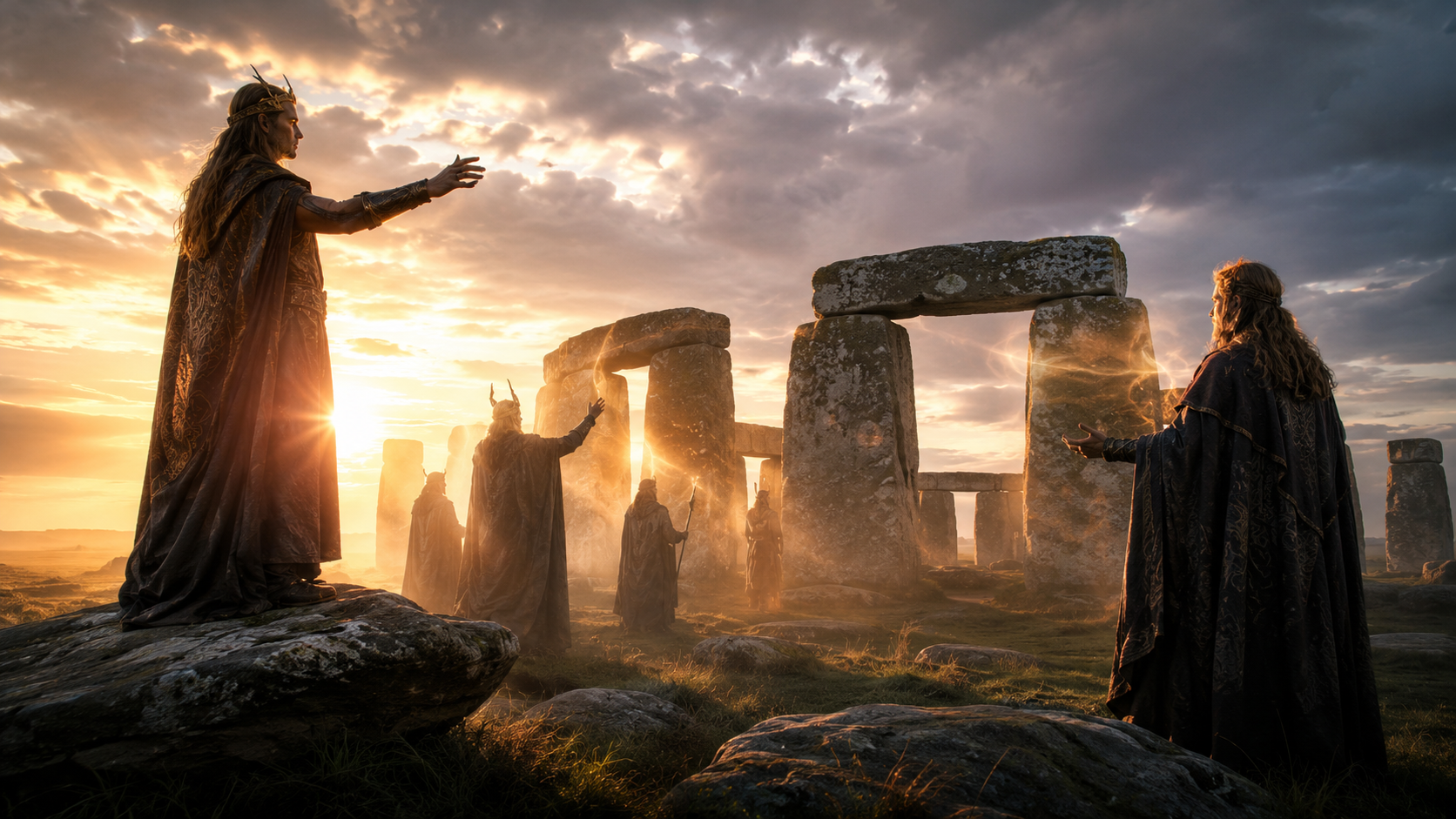
Another factor that was also decisive in the expansion of the New Age emerged from groups or societies in England and France. Neo-paganism reappeared following the discoveries of the megalithic monument known as Stonehenge. The well-known Anglican William Stukeley, around the year 1700, stated in his theories that he had observed that the axis formed by Stonehenge and the avenue in front of it pointed towards where the sun rises when the days are longest, the summer solstice. He also suggested that the arrangement of those “lithos” must have followed some kind of secret ritual, and that their builders, given the cyclopean size of the stones, must have been druids or even giants. The British, in particular, were drawn to the druidic, Celtic idea regarding the construction of these monuments. The Celts fought against the Romans, their invaders, and they reclaimed the role of these “mages”. People stopped seeing these monuments as mere stones fixed in the ground, apparently disconnected from their surroundings, and began to study them in relation to celestial bodies and their meridian position.
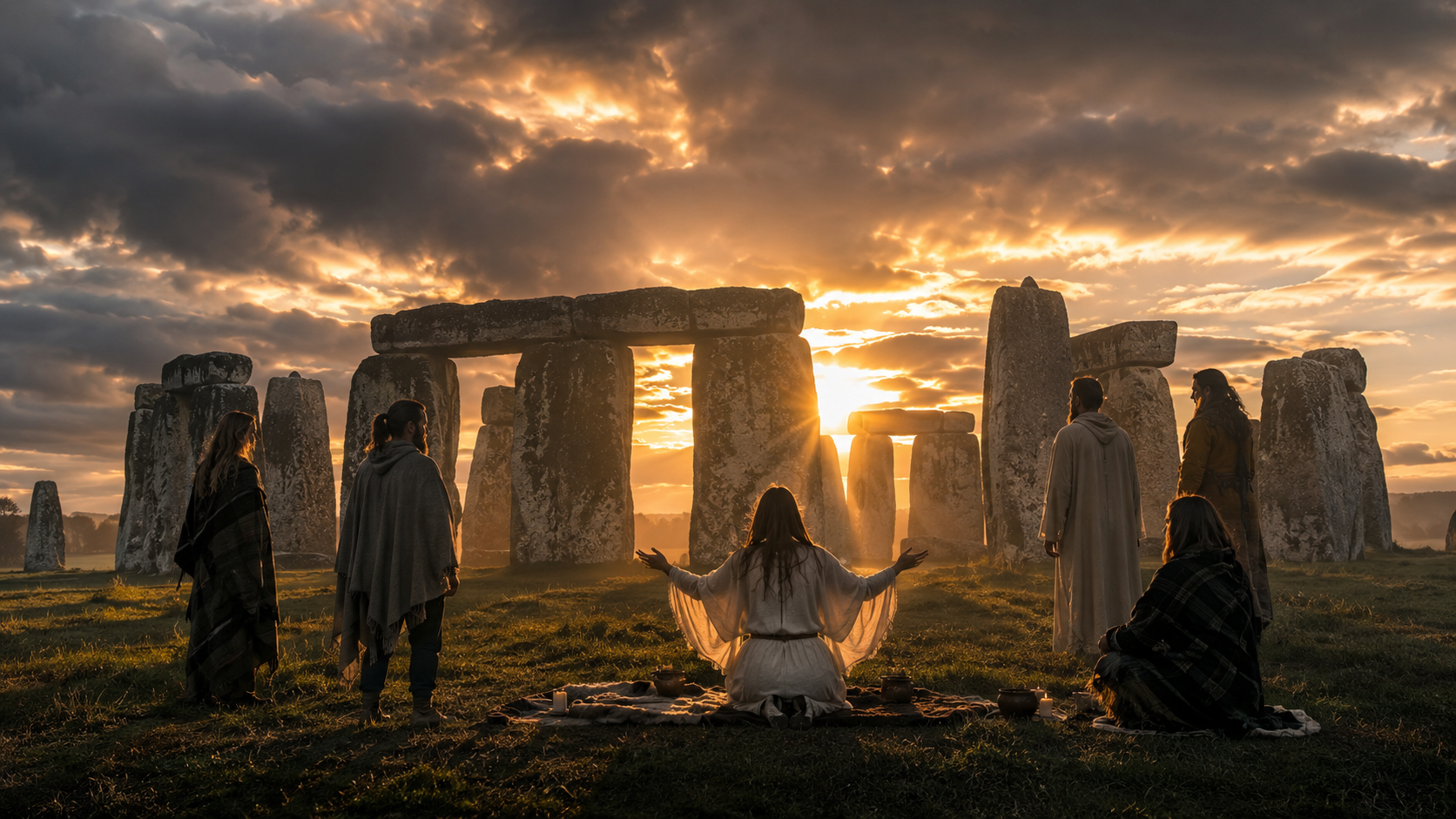
The idea we had of prehistory began to be questioned, since if these megalithic monuments were truly aligned with astronomical phenomena such as solstices or equinoxes, their importance took on almost cathartic dimensions. As a result, their creators came to be seen as truly wise individuals, almost divine architects and astronomers, who likely possessed linguistic, psychological and mathematical knowledge beyond our understanding. Over time, the druidic idea began to weaken, since this hypothesis could only be extended to other places with similar conditions, such as Ireland, Scotland, France, Spain or Portugal. However, the abundance of Neolithic monuments and the tradition of clans worshipping the “Great Mother” and “giants” was widespread, and megalithism itself is a phenomenon found across much of the world. New examples continue to appear, always linked to similar traditions: mountains or burial mounds, giants, priestesses and druids devoted to the Mother, sacred eggs, the tree of life, spirals, serpents or dragons. There are different architectural details, but always the same archaeo-astronomical narrative. Clearly, it was not the Celtic druids who built such structures. The British used the druidic idea in a nationalist sense, and a new druidic order was established. They appropriated all the monuments and “reconstructed” them according to their own civilisation. For thousands of years, people had forgotten the original meaning of these dolmens, huge mounds or stone constructions, since the original image had faded over time and the stories had been rewritten. From this rediscovery onwards, megalithic monuments, especially in Europe, with France and England as leading examples, came to be considered architectural wonders. This led to what became known as the “Megalithic Business” or megalomania. Who was responsible for creating these monuments? That is the great question.
For druidism, based on Celtic beliefs, they were the work of semi-divine beings known as the Tuatha Dé Danann. For conventional archaeologists and historians, they were built by unrelated clans, rejecting the archaeo-astronomical theories of William Stukeley or Alexander Thom, among others. For New Age movements, they are seen as constructions derived from an alien legacy. Other Neoplatonic and Hermetic movements also consider that all these monuments form part of an ancestral legacy. A humanity, perhaps of giants, that existed before our Homo sapiens civilisation and practised advanced technology through means we do not yet understand. This humanity disappeared due to a global cataclysm and may have been based in Antarctica. It has been referred to as Atlantis, Lemuria, Agartha, and so on. The new druidic religion, known as neo-druidism, attempts to reconstruct, through hypotheses, what the supposed age of the druids on Earth might have been like, the alleged builders of the megalithic temples. This is a difficult task to imagine, since the ancient druids disappeared long ago, and with them all their knowledge. As they supposedly had no written language, no original records remain. Only written evidence from authors considered enemies, such as Julius Caesar around 50 BC, in Book VI of his Commentaries on the Gallic War, has survived. In this work, he describes how druids were concerned with divine worship and played an essential role in Gallic society. It is said that druids had different roles within Celtic societies. They were healers and physicians, diviners and astrologers. What happened to the true druids? All of them disappeared. The Celtic druids who led these scattered groups were no longer the true druids that people in Britain associate with the “Tuatha Dé Danann”.