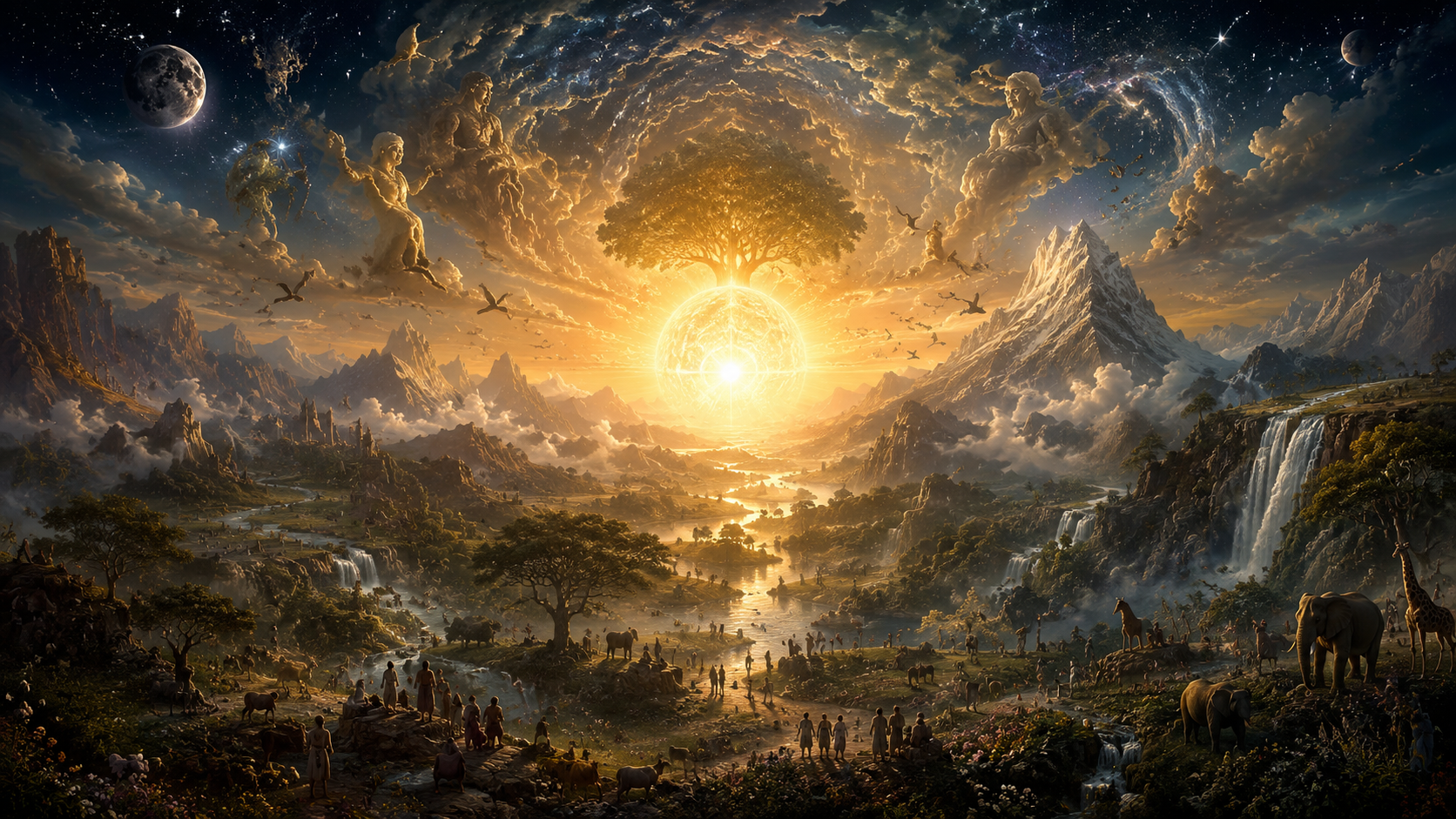
Hen to Pan: The One, the All (The Union of Opposites)
The Ouroboros is an ancestral symbol recognised in numerous civilisations throughout the millennia. The image has been seen in ancient Egypt, Mesopotamia, Japan, India, Greek texts, on Neolithic stones, indigenous tribes, etc. The Ouroboros is a global symbol. The name comes from the Greek ‘oura’ -tail- and ‘boros’ -eat-. Eating the tail, as a representation of the infinity and/or loop of things. In it, a worm, a snake or a dragon is shown, swallowing its own tail, thus forming a circle -a synthetic idea of perfection-. The serpent or dragon Ouroboros has survived since ancient times and dates back to Ancient Egypt -1600 BC- contained in the Egyptian Book of the Dead. In the famous drawing of Ouroboros of the alchemical text of Cleopatra, it appears with the inscription Hen to Pan which means: The One, the All. The serpent is represented by the black and white colour, demonstrating the principle of polarity present in the whole. And in turn reminding other symbols such as yin yang. In fact, it is said that since Chinese alchemy arrived in Alexandria, the Yin-Yang symbol, responsible for creation, was transformed into a symbol that today we call Ouroboros, and which the supporters of the New Age have used as a flag. The Chinese believed that Light and Dark - as ideal opposites -, when joined, produced creative energy. The two opposites were later perceived in a dual way as: matter and energy. This polarity is known as Yin-Yang, and its unit was called chi.
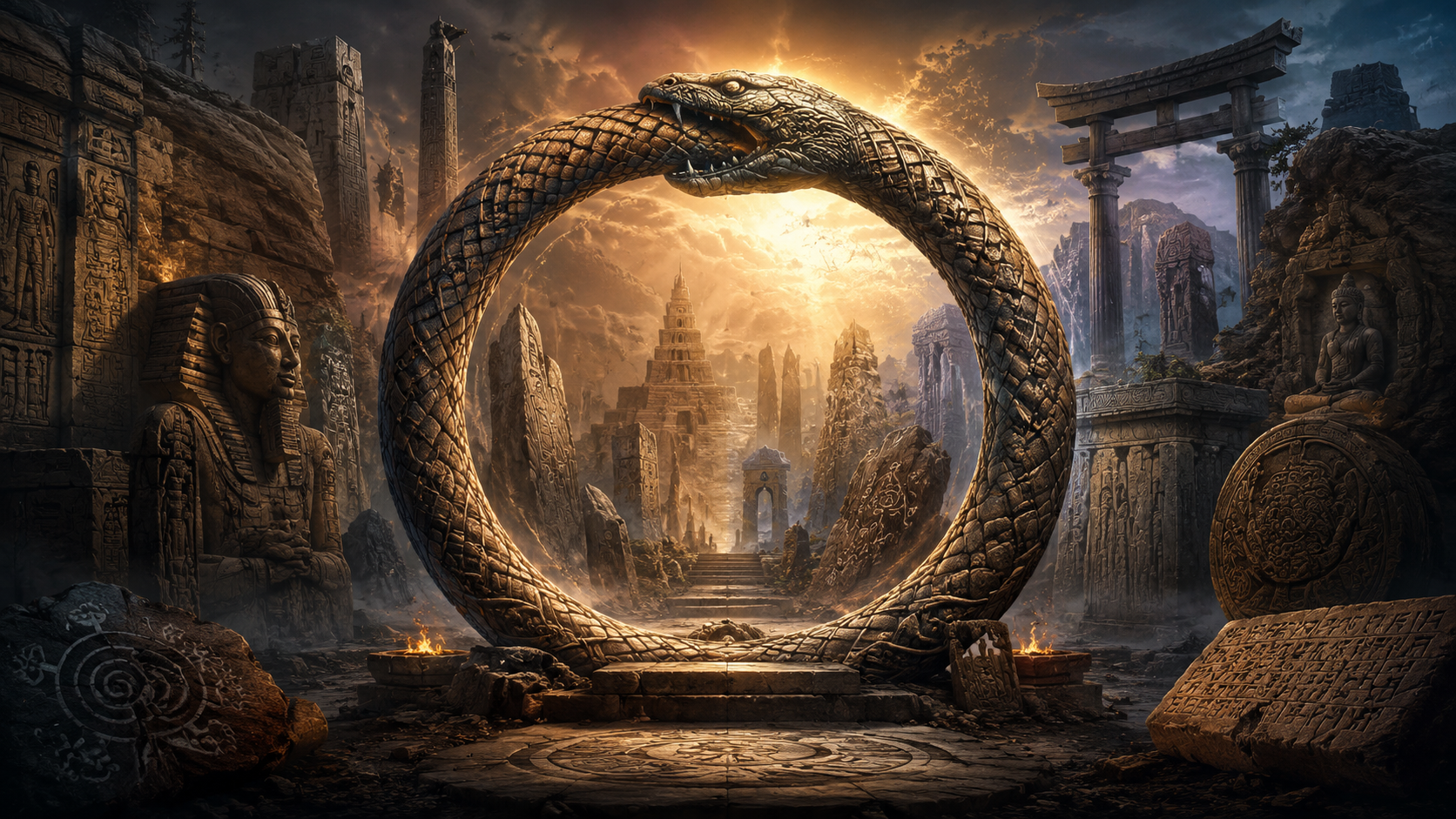
The symbol is associated with Hermeticism, Gnosticism and Alchemy. It would represent the cyclical nature of things, the eternal return. The fact that the serpent - ancestral wisdom - devours itself in a self-destructive way, makes the metaphor of the life cycle, where there is no visible border between the beginning or the end. The serpent or dragon -depends on the culture- devours itself, not as an apology for suicide, but a representation of self-love or self-fertilisation. A sublimation of the material, in pursuit of time and the continuity of life. In the Chou dynasties -China- we find engravings of Ouroboros -1200 BC- symbolising the continuity of life with the dragon biting its tail. In Norse mythology we find the gigantic serpent Jormungand -The Serpent of Midgard-, which grew so large that it could encircle the world until it caught its own tail with its teeth. In another myth Odin threw her into the sea that surrounds Midgard, where she would be trapped until the day of total destruction -Ragnarok- Mythology tells that with the arrival of Ragnarok, Jormundganer will crawl out of the ocean, poisoning the skies with the air it exhales from its jaws and crawl through the fire of the giants to the place where Thor, the god of thunder and his Nemesis, is to face each other in an epic combat. It has been thought that the symbol would be inspired by the Milky Way, as ancient records have been found referring to a serpent of light that dwells in the heavens. It has also been linked to the lunar cycle. In short, the Ouroboros expresses the unity of all things –the one, the whole-, the material and the spiritual, which never disappear but change form in the eternal creative cycle. In turn, it represents the conflict of life, in the sense that life comes out of life and death: “my end is my beginning.” I beget myself, I permeate myself, I kill myself, but in a cyclical rather than linear sense. It kills and gives life, fertilises and gives birth.
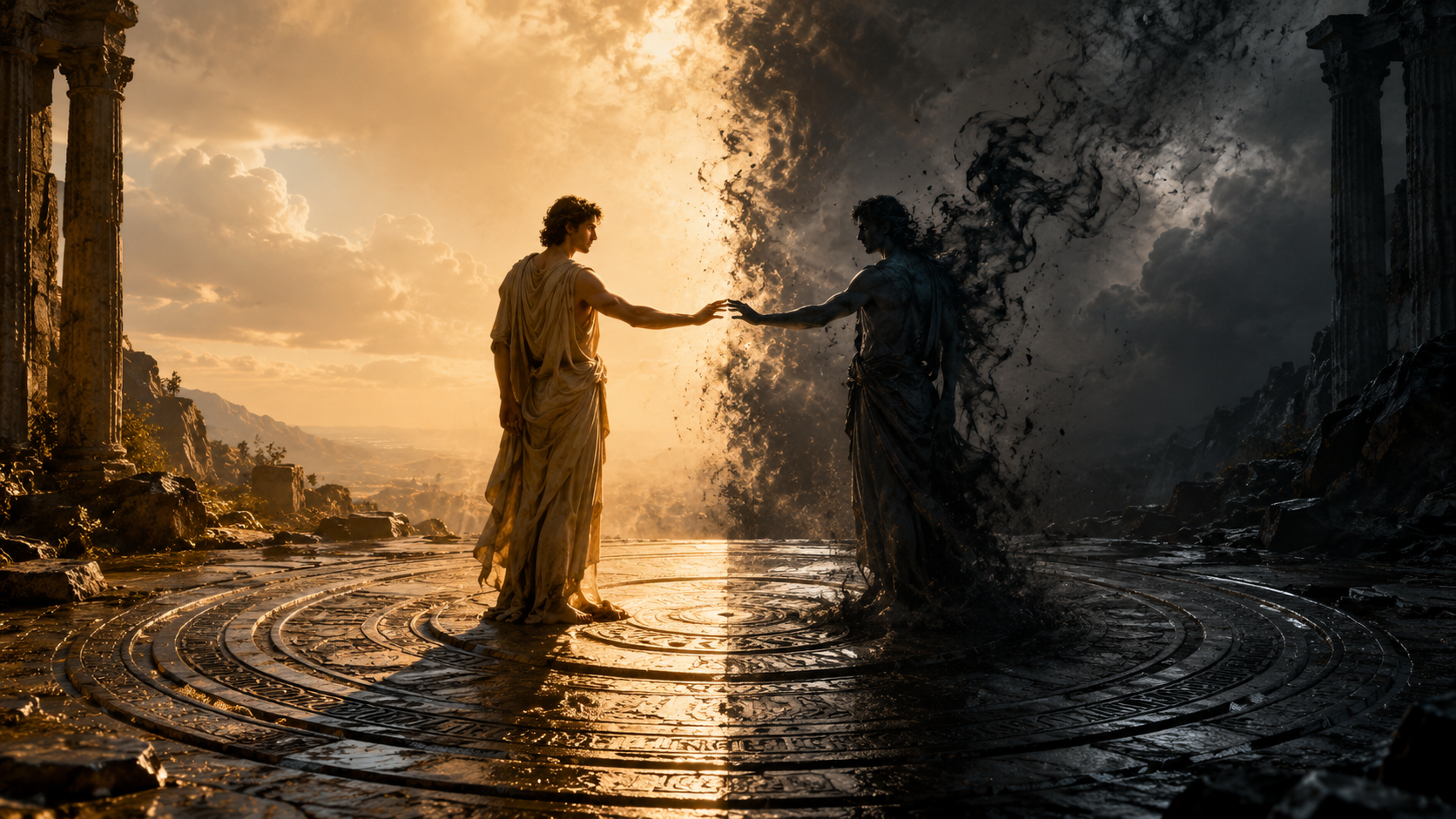
The symbol expresses the drama of integration for the assimilation of the opposite, that is, the shadow. Hermes the trimegistus, the scribe of the Egyptian gods and father of alchemy –and all the arts- defines the Ouroboros in this way: “Serpens culus caudam devorabit” –serpent that devours its own tail-. In Alchemy, the Ouroboros symbolises the circular nature of the alchemist’s work: integrating opposites. The conscious with the unconscious, and vice versa. Here we find that the serpent –beginning and ending- is reunited in a constant ritual of self-draining. This conception of the great work is linked to the path of the sun as well as to the reason for the pilgrimage of the hero. Thus, in the Ouroboros we find the union of the chthonic world -snake- with that of the celestial world -the circle that forms-. In itself it contains duality and a third invisible and fundamental element that makes everything exist: By biting its tail and being able to swallow itself, it is eternally recreating and regenerating. This form of balance –because it bites its tail- is the detail of death, because for there to be life, death must manifest itself. The Ouroboros would envision three steps for the manifestation of life: creation, sustenance and destruction. The antagonistic principles are Sulfur -lion, yang, fixed masculine- and Mercury -serpent, yin, volatile feminine-. The third principle would be the salt that provides balance to the two before superiors, allowing their integration. Ouroboros symbolism has been used to describe the Kundalini energy, and is equivalent to the entwined serpents of the caduceus or human DNA.
For the Swiss psychologist Carl Gustav Jung the Ouroboros represented the basic mandala of alchemy that has existed since ancient times. For him, the snake engulfing itself was one of the main archetypes of the human psyche. Jung defined the relationship of the Ouroboros with alchemy in this way: Ouroboros with alchemy in this way:
“The alchemists, who, in their own way, knew more about the nature of the individualisation process than we do today, expressed this paradox with the symbol of the Ouroboros, a snake that swallows its own tail. In the historical image of the Ouroboros is the thought of devouring oneself and becoming a circulatory process, because it was clear to the most astute alchemists that the raw material of art was man himself. The Ouroboros is a dramatic symbol for the integration and assimilation of the opposite, that is, the shadow. This process of ‘regeneration’ is at the same time a symbol of immortality, since the Ouroboros kills itself and brings life, fertilises and gives birth. He symbolises the proceeds from the clash of opposites, and therefore, constitutes the secret of the raw material that unquestionably comes from the very root of man’s unconscious. “