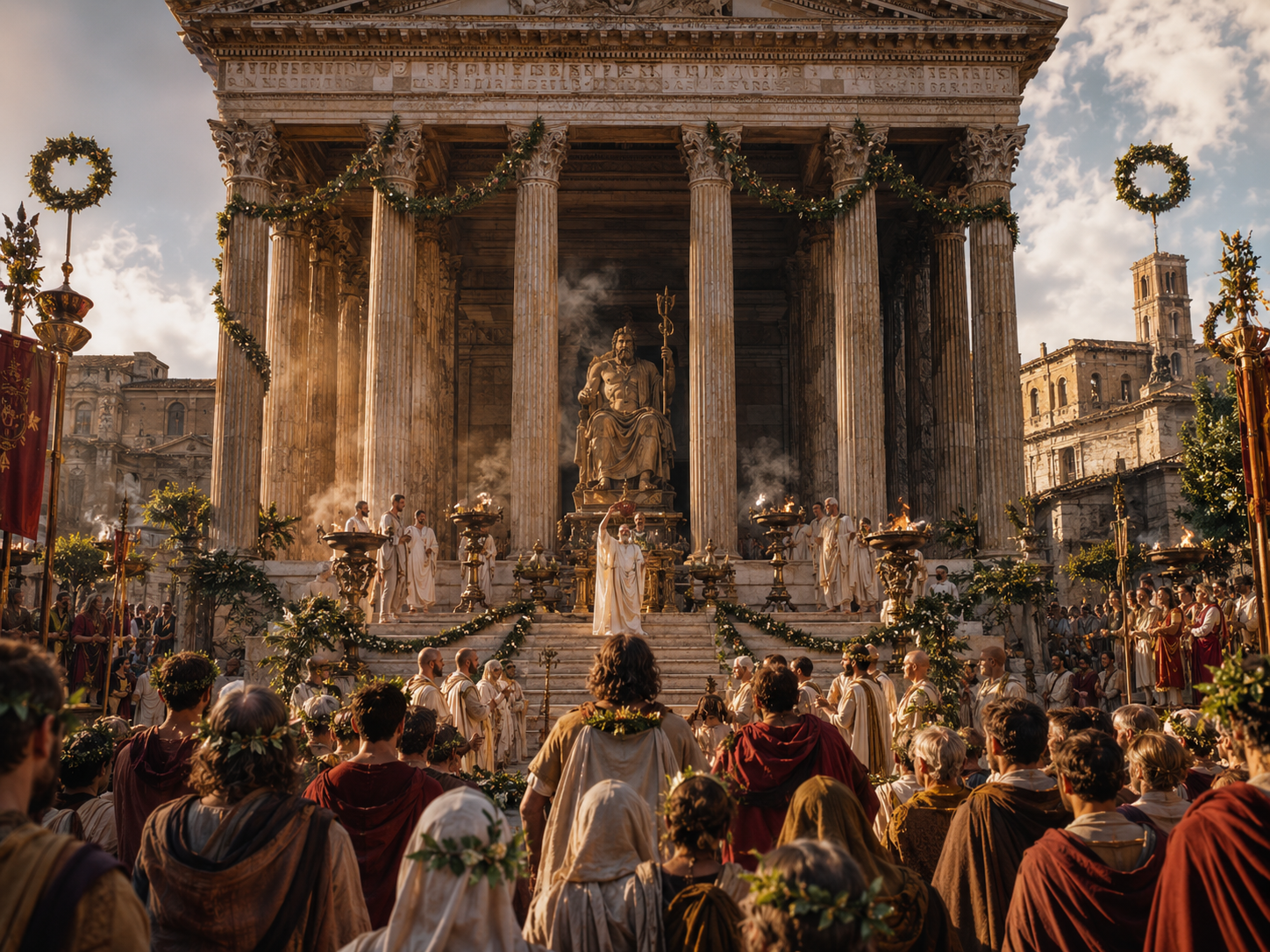
On the 18th of December, a kind of Roman-style carnival was celebrated; everyone wore masks in markets, bars, squares, and leisure spaces. On the 19th of December, the day of abundance was celebrated, in honour of the goddess Ops -Rhea: La Magna Mater-, consort of Saturn. On the 20th of December, candles were lit at night and people gathered in the streets celebrating the darkest days of the year. On the 21st of December, the day known as the Saturnalian games was held; Rome became a mock republic in which the humblest assumed public office, slaves overturned the laws of servitude and became masters for a day, and many women enjoyed public freedom without losing their reputation. On the 22nd of December, the armies chose a “king of misrule”, who was treated as a king for the entire day. At the end of the day, this chosen one would be sacrificed on the altar of the god Saturn, and the festival would continue until the following day On the 24th of December, the day was dedicated to the nurse of Romulus and Remus, the founders of Rome, Acca Laurentia. This festival was known as Laurentalia. On the 25th of December, the birth of the sun god Sol Invictus was celebrated; it was also associated with Mithra, the god of the legions. On the 26th of December, it was the day of women, in honour of the goddess Demeter. On this day, women mocked men and engaged in intimate relations among themselves. On the 28th of December, the day known as the day of the holy innocents was celebrated, in which Romans played pranks on one another. On the 29th and 30th of December, preparations were made for the closing festival of the Saturnalia. On the 31st of December, the day was known as the eve of Strenae, dedicated to the goddess Strenia; that night a great bonfire was lit which transformed and cleansed all the evils of the passing year.
Subsequently, the birth of the sun and its new cycle of light were assimilated by the Church, alongside Mithra, by Jesus of Nazareth, with the mission of ending pagan customs. From 221 AD, Sextus Julius Africanus popularised the 25th of December as the date of the birth of Jesus. Through the period in which the Council of Nicaea was organised in 325, and the establishment of Dies nativitatis et epiphaniae, until Pope Julius I requested in 350 AD that the birth of Christ be celebrated on the 25th of December, and finally in 354 AD Pope Liberius decreed that day as the birth of Jesus of Nazareth. Gradually, these celebrations were assimilated by new generations of Christians, becoming what we now know as Christmas, the birth of Jesus Christ.