The origin of solar monotheism (when the light challenged the system)
Schools were designed in ancient times according to the needs of the context. This was determined mainly by political ideology and religious beliefs. Mesopotamians and Egyptians were governed by absolute emperors and pharaohs, descendants of gods who had inhabited the Earth in an even more remote time. Thus, the first known schools were developed. These were academies for the priesthood, where mathematics and astronomy were taught. Priests were creators of myths and, in turn, designers of the monuments of their time. Other academies were oriented towards the artisanal sphere, where agricultural trades and military arts were learned. However, all this type of education was reserved for the noble classes, the elite families of each civilisation. Those who would one day occupy a place among the most important. The hierarchical social pyramid was established from what we now understand as the beginnings of history. Chinese, Indians, Greeks and Romans also adopted similar educational systems, always based on the needs of the context and imposed by the corresponding leader.
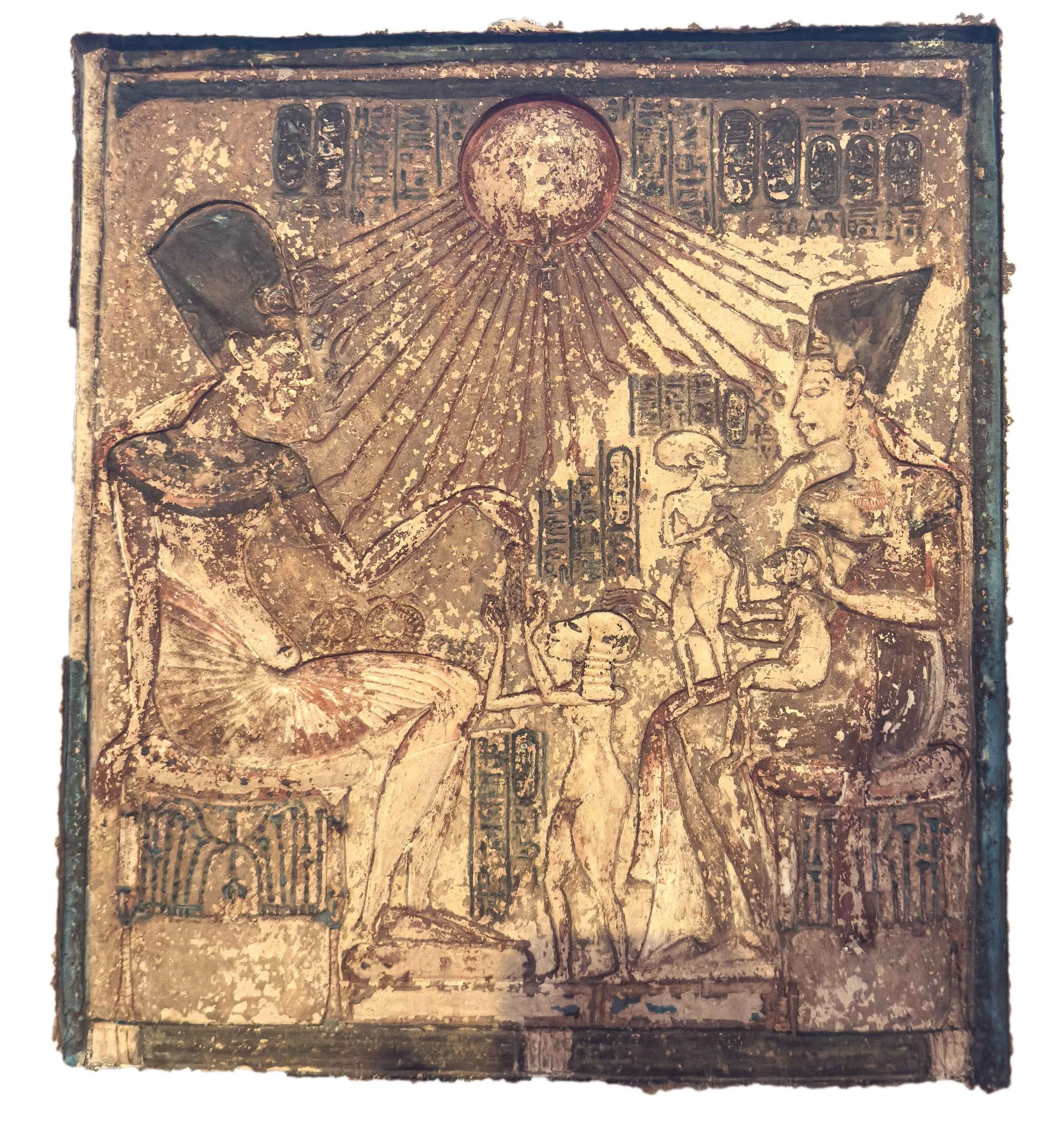
A clear example of how the educational system functioned can already be found in ancient Egypt, with the pharaoh Akhenaten, tenth monarch of the Eighteenth Dynasty, known as “the heretic”. His original name was Amenhotep IV, which means “Amun is satisfied”, but he changed it to Akhenaten, which means “The horizon of Aten”. When Akhenaten came to power, in the year 1353 BC, laws, faith and commandments were dictated mainly by the priests, who had accumulated the greatest privileges -that is, control of the government above the pharaoh himself-. Everything revolved around the religion of the sun god Amun-Ra and the rest of the pantheon. Akhenaten, together with his wife Nefertiti, decided to challenge the entire religious and legal system of ancient Egypt. His revolutionary idea consisted in replacing the worship of the gods of Amun-Ra -Amun was considered the supreme god and father of the gods in the Egyptian pantheon, equivalent to Zeus- with that of a single solar god called Aten -the word “Aten” means “disc”, referring literally to the solar disc-. He, Akhenaten, presented himself as the true pharaoh, the living god, and therefore capable of changing everything: religion, politics and art. And so he did. From then on, he would be known as “the horizon of Aten”, that is, the only one in direct contact with the Sun god -in this way, the pharaoh recovered power as sovereign, above the priests of Amun, who had come to hold as much or even more power than him-. The two thousand gods with animal or human form were replaced by a single one, abstract: the Sun, the one who illuminated the pharaoh with its rays. Akhenaten also abandoned the sacred city of Thebes -the heart of the nation- in search of a new promised city, located to the north of the Nile. For the traditional priests, who had dedicated their entire lives to the worship of the ancient gods, the growing loss of power in matters of law and faith turned Akhenaten into the pharaoh who would drag Egypt into disgrace. The new sovereign and his wife had created powerful enemies.

In the fifth year of his reign, Akhenaten granted his wife Nefertiti the title of Great Royal Wife and equality of power. Thus, together they travelled some 320 kilometres until they reached the city that we now know as Tell el-Amarna. According to Akhenaten, the god Aten told him: “Build here”, through a sign, presumably a sunset. Thousands of people moved from the ancient city of Thebes to Amarna to build, decorate and organise the new capital of the kingdom. Wells were dug, trees and gardens were planted, and in this way the sacred city of Amarna flourished. Houses and palaces were also built, beautifully decorated, just as had been done with the temples dedicated to the one god Aten. The vision of Akhenaten and Nefertiti became reality, when it barely seemed more than a utopia. This sun god, called Aten, was represented in the form of a solar disc with rays that extended like arms and invisible hands that gave life and prosperity. A Sun God based on love and tenderness. A god of infinite kindness and generosity, who watched over justice and cosmic order, a light that benefited all races equally. The sovereign of peoples -the pharaoh- was his envoy and his prophet on Earth, the only one worthy of immortality. Aten was that one God -Ra- who had ended up being eclipsed by other luminaries and god-men. These religious changes were also reflected in architecture. Traditionally, temples dedicated to the god Amun-Ra, or solar cults, were developed in enclosed spaces, where light entered only occasionally or in a very limited way. But during Akhenaten’s reign, the cult of Aten brought with it open-air sanctuaries, instead of traditional enclosed spaces. And this is interesting to understand, since the cult of Amun-Ra focused on the hidden and the dark, whereas for the followers of Aten, what governed their worship was revealed light. In the first nine years of Akhenaten’s reign, Aten was identified as Ra-Horakhty: “He who rejoices on the horizon”. Ra represented the essence of the solar disc, with which the pharaoh of the moment would merge.

What seemed a reality worthy of celebration soon came to an end, when a plague ravaged the lands: an epidemic that probably killed 40% of the population. Among the victims were several daughters of the pharaoh. He was considered responsible for the tragedy, since, according to the priests, he had offended the gods who had once protected them so greatly. Thirteen years after the founding of Amarna, Akhenaten died. After his death, there was a brief reign of someone called Smenkhkare, who in reality may have been Nefertiti masculinised as a woman-pharaoh. However, he was soon succeeded by Tutankhaten, the son of Nefertiti and Akhenaten. No one knows what happened to the queen; all information was lost, although some say that she continued to act in the shadows, together with her son and the new queen, the third daughter of Akhenaten: Ankhesenpaaten. In any case, around 1331 BC, the new pharaoh renounced the monotheistic cult of his father, taking the name Tutankhamun and restoring the worship of Amun-Ra. The royal family abandoned Amarna and restored the power of the priesthood in the capital, Thebes. The priests became more powerful than ever; no pharaoh would again challenge the laws or the faith. The cult of Aten was intensely erased from the map by the destructive intervention of later pharaohs. No one would speak again of Akhenaten or of the cult of Aten. He would only be remembered as the father of the great pharaoh Tutankhamun. The Egyptians returned to the worship of Amun along with all their gods.